
Most wheelchairs stop at the sidewalk. Ours don't.
The RoughRider and Aurora are engineered for trails, gravel, packed sand, cobblestones, and everything in between.

Nearly half of all falls are forward, and forward falls carry the highest risk of serious injury, including head impact, fractures, and concussion.
Most occur outdoors, where uneven terrain, ramps, and curbs catch standard wheelchairs off guard.
The RoughRider and Aurora are engineered to address this. A long wheelbase, wide-track casters, and balanced geometry dramatically reduce tip risk, especially on the rough surfaces where standard chairs fail.
Sources: AliMed | American Journal of Physical Medicine & Rehabilitation | NIH
⇆ Swipe to compare all three chairs
| Recommended Aurora $1,695 Lightweight aluminum | RoughRider $895 Steel frame | Typical Outdoor From $2,995 Market average | |
|---|---|---|---|
| Weight | 34 lbs | 44 lbs | 46 to 54 lbs |
| Rust resistant | ✓ | No | Varies |
| Anti-tippers | Included | Contact us | Extra cost |
| Cushion | ✓ | ✓ | Varies |
| Warranty | 6yr frame / 1yr parts | 6yr frame / 1yr parts | Typically 2 years |
Have questions? We are a small company and happy to help personally. Contact us before you order.
Typical outdoor wheelchair data based on publicly available market information as of 2026.
The RoughRider was designed by Whirlwind Wheelchair International, a 501(c)(3) nonprofit with 40 years of history designing rugged and durable wheelchairs for use in developing countries. RoughRider America LLC has improved the original RoughRider and introduced the Aurora, a lightweight aluminum version. We are a private company focused entirely on producing and supporting these two chairs, in the US and internationally.
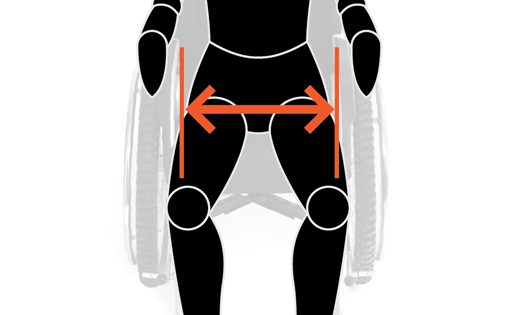
To find the distance between your hips, first position yourself seated with pelvis upright on a firm surface. Then, measure the distance between the widest points of the hips and thighs without compressing any tissue. Finally, record your measurements. It is important not to have a chair that is wider than necessary as it will be harder to push and may prevent you from passing through narrow doorways.
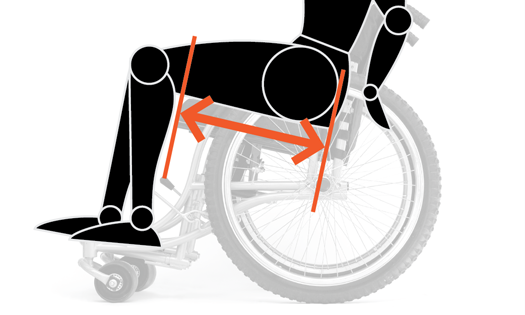
Position yourself seated upright on a firm surface. Measure the length of your upper leg, the distance from behind the knee to the back of the pelvis (back of your lower leg). Subtract 1/2” to find the maximum seat depth, to allow for space between the back of the knee/upper leg and seat fabric. Record the final measurement.
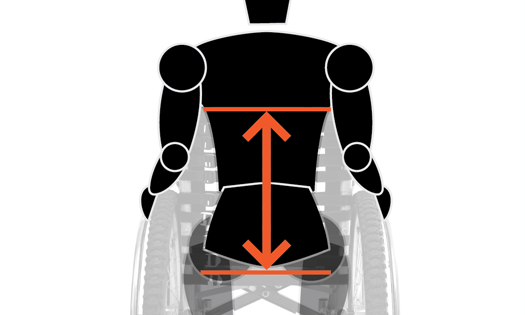
Your preferred backrest height is determined by your personal comfort level and physical ability. Whirlwind recommends, generally, that the top of the back support should fall just beneath the bottom of the shoulder blade. For less active riders who require more torso support, the back support should be higher, falling just beneath the armpit. Position yourself seated upright on a firm surface. Hold your hands flat against the surface you are sitting on. Measure the distance from the seated surface to the desired, most comfortable point for support on your back. To this number add the height of your cushion when you are sitting on it. Record the measurement.
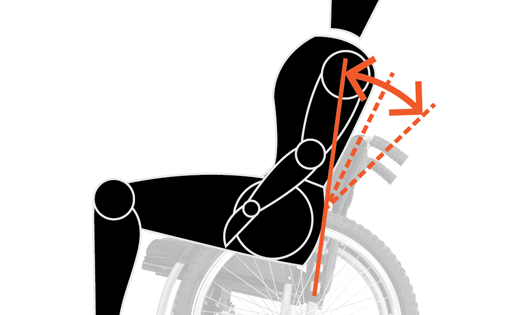
Backrest angles are determined by the torso control of the rider. Whirlwind recommends that those with less torso control, such as quadriplegics, sit with a backrest angled further backwards to avoid falling forward in a wheelchair. Those with more torso control, such as amputees, can sit with the backrest more upright. Proper backrest angle is best determined by an occupational therapist or healthcare professional. Although there is only one option – 8 degrees – in the drop-down list below, you can adjust the backrest angle by adjusting the backrest straps (i.e. looser at the bottom and tighter at the top for a more erect position).
Now please enter your measurements into the fields on the product page before ordering. For more information about measuring, please refer to the RoughRider Fitting Sheet. You are responsible for choosing the right chair for yourself. If you are uncomfortable with determining your wheelchair size, please consult a professional.