
How do I assemble my chair?
Assembly instructions and videos for both the RoughRider and Aurora are available on our Support page. User manuals for both chairs can be downloaded from our Manuals page. Each chair ships with a basic toolkit. The following adjustments may be needed at setup: seat back height, seat depth, footrest position, rear wheel axle position, brake position, and wheel attachment.
Please refer to this instructional video
How do I adjust the backrest height on the RoughRider?
The RoughRider backrest can be set to four heights: 11″, 13″, 15″, or 17″. Height is adjusted by repositioning the Velcro straps on the backrest rails. Full instructions, including diagrams, are in the RoughRider User Manual.
How do I adjust the backrest tension?
On both chairs, backrest tension is adjusted by tightening or loosening the backrest straps. For a more upright back position, tighten the straps at the top and loosen at the bottom. For a more reclined position, do the opposite. Riders with less trunk control generally do better with a more reclined angle. If you are unsure what position works best for your body, consult an occupational therapist or healthcare professional.
How do I adjust the rear wheel position?
Both chairs have multiple axle positions that let you move the rear wheels forward or backward. Moving the wheels forward makes the chair easier to push and easier to get over obstacles, but increases the risk of tipping backward. Moving the wheels back makes the chair more stable. Start with the wheels in the rearmost position while you are learning. Full instructions are in your user manual, available on our Manuals page.
How do I adjust the wheel locks (brakes)?
Brake adjustment instructions for the RoughRider are available on our Support page. If you need help with your Aurora’s brakes, please contact us.
Most parts on both the RoughRider and Aurora can be repaired or replaced locally. The exceptions are the caster wheels, which you can order directly from us. The rear wheel bearings can be purchased online or at an automotive store. Tires, spokes, and rims can be purchased from a bicycle shop. The hub is a specialized wheelchair hub and should be used when building a new wheel. A bicycle or wheelchair repair shop can replace any rear wheel parts. All other nuts and bolts can be purchased from a local hardware store or online. Check the parts specifications on each product page before purchasing.
Order Replacement Caster Wheels
Which parts can I order directly from RoughRider America?
Replacement caster wheels (front wheels) can be ordered directly from us on our Replacement Caster Wheels page. These are the specialized component most likely to need replacement over time.
Where do I get replacement rear wheel parts?
Rear wheel tires, tubes, spokes, and rims are standard bicycle parts available at any bicycle shop or online. Rear wheel bearings can also be found at bicycle shops or automotive stores. All other nuts and bolts can be sourced from a local hardware store.
How do I fix a flat tire?
Instructions for fixing a flat are available on our Manuals page under “How to Fix a Flat.” Each chair also ships with a patch kit and pump for this purpose.
How do I install or remove the quick-release rear wheels?
Step-by-step instructions are available on our Manuals page under “Quick Release Rear Wheel Assembly.”
Can I order replacement wheel locks (brakes) for an older RoughRider?
Yes. We now use standard Quickie brakes, which can be purchased online. Search “Quickie push-to-lock wheel locks” on Southwest Medical to find a compatible set.
My chair needs a repair not covered here. What should I do?
Most repairs can be handled locally. A bicycle mechanic can help with wheels, tires, tubes, spokes, and bearings. A hardware store can supply standard nuts and bolts. For anything else, contact us and we will help point you in the right direction.
How often does my chair need maintenance?
Weekly: check tire pressure and inspect your seat cushion for wear. Monthly: lubricate the bearings and inspect the upholstery. Every two months: check and tighten spokes, lubricate pivot points, tighten any loose nuts and bolts, and do a full cleaning and inspection. Once or twice a year: do a thorough bearing cleaning and repacking. Your full maintenance schedule is in the User Manual.
How do I clean my chair?
Wipe down the frame and upholstery with mild soap and water, then rinse and dry completely. Pay special attention to the axles, caster barrels, and X-brace pivot points. After the chair is fully dry, apply a medium- to heavy-weight oil to all moving parts to prevent rust and keep everything operating smoothly.
Do I need to use a cushion?
If you have limited or no feeling in your buttocks and legs, a pressure relief cushion is essential. A pressure sore can develop in as little as 20 minutes of sitting on the wrong surface and can become a serious medical complication. Use a firm, resilient foam cushion and replace it when it shows signs of wear. If you have full sensation and good circulation, a cushion is still recommended for comfort and posture. The Aurora includes a pressure relief cushion. The RoughRider does not.
What are Anti-Tippers and do I need them?
Anti-tippers are small rear-facing wheels that prevent the chair from tipping backward. If you are new to wheelchair use, or have any concern about tipping backward, we strongly recommend using them while you are learning. Assembly instructions are available on our Manuals page. Please contact us to confirm current availability.
Are the wheel locks the same as brakes?
No. Wheel locks are parking brakes only. They are designed to hold the chair still when it is stopped, such as during transfers. Do not use wheel locks to slow down a moving chair.
What is the delivery timeframe?
Within the USA and Canada, it is typically 2 to 5 business days, starting with the day following the order. The specific number of days depend on where you are located.
Where do you ship?
We ship to the USA, Canada, Europe, Australia, and New Zealand. For large-volume orders or developing world pricing, contact us.
Do you offer a warranty?
Yes. The wheelchair frame is covered against defects for 6 years. All other components are covered for one year from the date of purchase. Please review our full Warranty and Return Policy before purchasing.
Can I return my chair?
We have a limited return policy. Please read the full Warranty and Return Policy carefully before ordering.
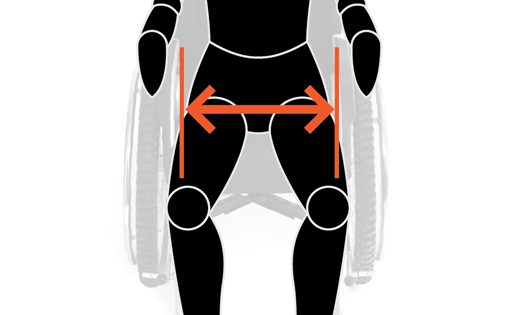
To find the distance between your hips, first position yourself seated with pelvis upright on a firm surface. Then, measure the distance between the widest points of the hips and thighs without compressing any tissue. Finally, record your measurements. It is important not to have a chair that is wider than necessary as it will be harder to push and may prevent you from passing through narrow doorways.
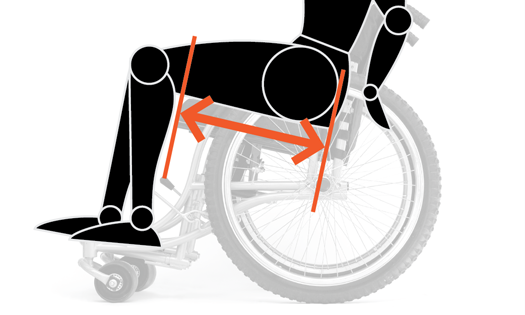
Position yourself seated upright on a firm surface. Measure the length of your upper leg, the distance from behind the knee to the back of the pelvis (back of your lower leg). Subtract 1/2” to find the maximum seat depth, to allow for space between the back of the knee/upper leg and seat fabric. Record the final measurement.
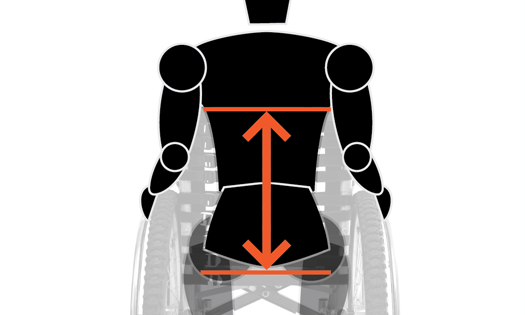
Your preferred backrest height is determined by your personal comfort level and physical ability. Whirlwind recommends, generally, that the top of the back support should fall just beneath the bottom of the shoulder blade. For less active riders who require more torso support, the back support should be higher, falling just beneath the armpit. Position yourself seated upright on a firm surface. Hold your hands flat against the surface you are sitting on. Measure the distance from the seated surface to the desired, most comfortable point for support on your back. To this number add the height of your cushion when you are sitting on it. Record the measurement.
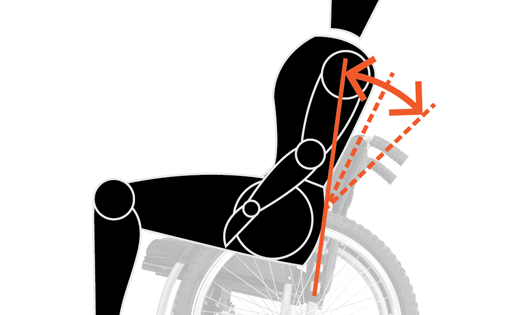
Backrest angles are determined by the torso control of the rider. Whirlwind recommends that those with less torso control, such as quadriplegics, sit with a backrest angled further backwards to avoid falling forward in a wheelchair. Those with more torso control, such as amputees, can sit with the backrest more upright. Proper backrest angle is best determined by an occupational therapist or healthcare professional. Although there is only one option – 8 degrees – in the drop-down list below, you can adjust the backrest angle by adjusting the backrest straps (i.e. looser at the bottom and tighter at the top for a more erect position).
Now please enter your measurements into the fields on the product page before ordering. For more information about measuring, please refer to the RoughRider Fitting Sheet. You are responsible for choosing the right chair for yourself. If you are uncomfortable with determining your wheelchair size, please consult a professional.
Nothing to show here right now